16 July 2025
London TravelWatch’s 25th anniversary invites us to consider a paradox: how did the humble bus – once synonymous with delay and diesel fumes – become the quiet engine of London’s social democracy? The answer lies not in grand engineering feats, but in the subtle recalibration of urban values. Over two decades, buses evolved from transport afterthoughts into instruments of equity – a metamorphosis I observed from council chambers to TfL’s boardroom.
The unseen revolution
When London TravelWatch was born in 2000, buses occupied a curious space in civic consciousness: indispensable yet unloved. They carried cleaners, students, and shift workers – populations often overlooked by transport planning. The transformation began when policymakers recognised buses not merely as vehicles, but as social infrastructure. This shift in philosophy – from moving bodies to nurturing communities – became the bedrock of change.
The three silent shifts
 Accessibility as social covenant
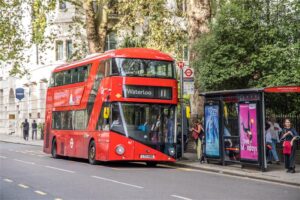
The early 2000s birthed a radical idea: that boarding a bus should demand no more effort than entering a public library. Low-floor buses arrived not as technical upgrades, but as statements of belonging. Suddenly, wheelchair users could ride without negotiation; parents with buggies no longer performed acrobatics at kerbsides. I recall borough debates where accessibility was dismissed as “costly idealism”. Yet today, when 65 percent of disabled Londoners use buses weekly, we see vindication: inclusion is not expenditure, but investment in civic dignity.
The double-edged digital dawn
Technology promised liberation but risked exclusion. The Hopper Fare – conceived in austerity but born in 2016 – became London’s great social leveller. By erasing financial penalties for transfers, it acknowledged the reality of low-wage work: a care worker travelling from Dagenham to Ilford shouldn’t pay twice. Yet for all its grace, the digital revolution left shadows. At Ealing’s community forums, I heard pensioners lament the dying paper timetable – a lifeline when smartphones felt like foreign objects. True progress demands analog bridges: voice announcements at stops, and ticket offices staffed.
Green machines as moral imperative
Buses became climate soldiers not through virtue, but necessity. The ULEZ standards forced a reckoning: either retrofit or retire. By 2020, the fleet’s NOx emissions had plummeted 90 percent – a victory for asthmatic children near busy roads. Yet the electric transition reveals uncomfortable truths. Charging depots demand land in a city allergic to sacrifice; grid upgrades need Treasury funding that flows, not trickles. The zero-emission bus is both triumph and test: can we decarbonise without displacing the communities buses exist to serve?
The ripple effects
Buses excel where rails cannot reach. Consider the night network: while the Tube sleeps, the N207 ferries hospital porters and bakers across the darkened city. Or the Superloop’s express corridors – planned during my TfL tenure – which collapse distances between Harrow and Heathrow, knitting outer London into the metropolitan fabric.
These services generate quiet revolutions:
- A teenager in Thamesmead reaches college without excessively long walks
- A market trader in Southall sees footfall rise 22 percent after bus lanes arrive
- Night-shift workers gain precious minutes of sleep as journey times fall
The bus is the great connector – not just of places, but of possibilities.
The unfinished journey
London TravelWatch’s anniversary is less celebration than checkpoint. Three challenges loom:
The Outer London divide
Beyond the North Circular, orbital journeys remain a test of endurance. Express routes like the Superloop help, but true equity demands 24/7 priority lanes on arteries like the A312 – where buses still crawl behind single-occupant cars.
The digital tightrope
As apps replace ticket windows, we must ask: who gets left behind? Solutions exist – community digital literacy programs, voice-activated information points – but require boroughs and TfL to prioritise inclusion over efficiency.
The space wars
Reallocating road space sparks conflict. Tottenham Court Road’s transformation – from traffic sewer to flowing bus corridor – proves the payoff: journey times down 25 percent, footfall up 18 percent. Yet too often, local resistance privileges parking over people. As I argued at London Councils: “When we prioritise a stationary car over a moving bus, we choose stagnation over community.”
Why buses endure
In twelve years navigating London’s governance labyrinth – from Ealing’s ward meetings to pan-borough negotiations – I learned that buses are the city’s connective tissue. They serve the margins: estates beyond the Tube map, night workers, those priced out of convenience.
London TravelWatch’s legacy lies in holding power to account – ensuring buses remained accessible during austerity, affordable during crisis, and clean when pollution seemed inevitable. As we look ahead, the bus remains London’s most democratic instrument. Its next chapter must ensure that no Londoner needs a car because the bus – equitable, green, and woven into every street – is always the better choice.
Julian Bell was former Leader of Ealing Council (2010–2021), Chair of London Councils’ Transport & Environment Committee (2014–2020), and TfL Board Member (2020–2022), and is a member of the London Bus Alliance
*Julian Bell’s cross-sector leadership spanned pivotal bus reforms, including the Hopper Fare rollout, Superloop planning, and zero-emission transition during his TfL Board tenure (2020–2022).*