
02 March 2026
As we approach three years since we published our first report into digital exclusion and disadvantage on London’s transport, Left behind Londoners, the momentum continues to swing in the direction of a digital-first approach. Our more recent campaign Logged Out delved into these issues in even more detail, highlighting some of our key concerns.
Since the publication of the latest report, we have been working with transport operators to urge them to do more to recognise and support those who are digitally excluded.
How can digital exclusion affect people using public transport?
If you have recently booked tickets online to make a journey by train, or turned up at a Tube station and simply tapped your phone to enter and exit the ticket barriers, you probably haven’t given much thought to those people who do not have smart devices or access to the internet. But if you are not online, travelling by public transport is becoming increasingly difficult.
Last year, a survey by charity Age UK found that many people over the age of 60 feel left behind by the shift to “digital first”, meaning many of them struggle to access a range of services because everything needs to be done online.
London TravelWatch has long been calling for transport companies to do more to take into consideration the needs of those people who might not have access to new technologies. And this is a significant number of people – in 2022, a report by London Office of Technology & Innovation found that over 250,000 Londoners had no internet access at all, and two million had very limited digital engagement.
Confusion and inconsistencies
One key issue for people who are travelling by train is that the support available can differ dramatically from station to station. For example, some stations will provide physical timetables, while others will signpost people to a website to access this information. Some ticket machines have help buttons linking to remote staff who can help passengers use the machine, while others have nothing. Some stations accept cash, while others don’t (more on this later).
This means that if you are travelling without a smartphone, you have no guarantee that the support you need will be available at the stations you are travelling to and from. These inconsistencies can be confusing and could put people off travelling altogether.
Going cashless
Another major concern is for those who want – or have – to use cash to buy tickets for travel. Research carried out by the British Retail Consortium found that cash usage is on the rise after a decade of declining use, and that one in five purchases was made using cash in 2024.
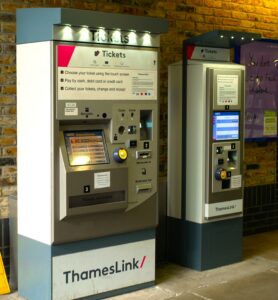 For certain groups, the ability to use cash may be a necessity. This might include people in abusive relationships whose partners use a bank account to control or track their movements. Similarly, older adults, individuals with mental health issues, and those with limited digital skills may feel more comfortable using cash for transactions and might lack the confidence to use cards or mobile phones to pay for everything.
And while only around one percent of passengers use cash to purchase their tickets to travel on Transport for London (TfL) services, with millions of journeys being made on its services every day, this is still a significant number of people who shouldn’t be ignored.
But despite the number of people using cash to buy tickets, our research found that they will likely be penalised for doing so. Buying a paper ticket from a ticket machine to travel on the Tube will cost – in some cases – over 200 percent more if you use cash (or card) to purchase the ticket, compared to if you tap in and out at the ticket barriers.
As well as penalising those who use cash to buy tickets, this penalises anyone who decides to buy a ticket from a ticket machine, which includes those who might not travel by Tube very often such as the millions of visitors to London.
What we did next
In the face of these concerning findings we wanted to push industry to take further steps to support digitally excluded groups, and to make sure they weren’t unfairly disadvantaged or penalised for not using technology.
As well as meetings with Transport for London and the Rail Delivery Group, we spoke with various train operating companies (TOCs) including c2c, Southeastern and Southwestern, GWR and GTR. We urged them to do more to make sure passengers were able to pay with cash and were not penalised for doing so, to make information provision more accessible and consistent, and to make sure staff were easy to find and had the skills and knowledge to help people.
Though there is appetite amongst industry to make sure digitally excluded and disadvantaged passengers have the support and information they need to travel easily and accessibly, this hasn’t yet fully translated into sufficient concrete action. We’ll be continuing to liaise with the operators to make sure they continue to make their services as accessible as possible, including to those who might not have access to digital technologies.
While we’ll be keeping an eye on digital exclusion and disadvantage, we know there are many other barriers in transport that also need to be addressed to move towards a more accessible network. In the coming months we’ll be looking in detail at step-free access and other facilities such as toilets, and alongside this work we will continue to push for more accessible transport for everyone.